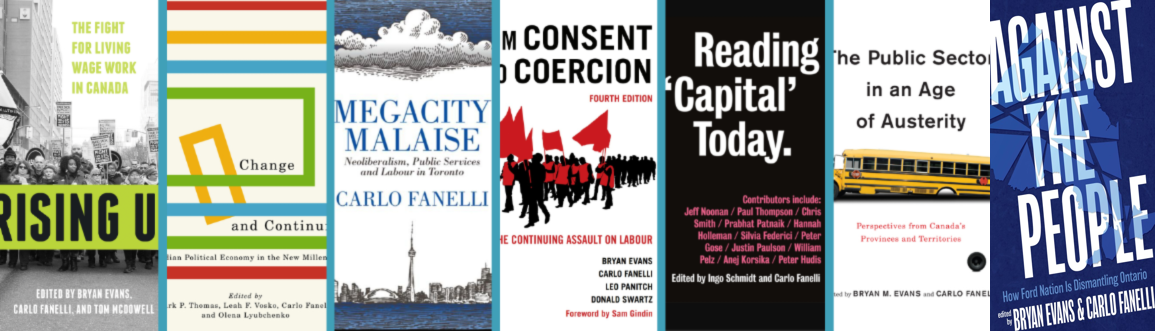
Carlo Fanelli is Associate Professor of Work and Labour Studies and Chair of the Department of Social Science at York University, Toronto, Canada. Previously, I served as Interim Director of the Global Labour Research Centre (2024-25), and Coordinator of the Work and Labour Studies program (2017-2022). I am appointed to the Graduate Programs in the Department of Politics, and Department of Sociology. My teaching and research span the fields of work and labour studies, political economy, law and comparative politics, with a sustained focus on the dynamics of inequality, state regulation, and globalization.
My current work revolves around three major projects that examine the changing dynamics of work, labour, and political economy. The first explores how austerity has reshaped public finances, services, and workers’ experiences in Canada, situating these developments within a comparative international context to highlight both divergences and shared patterns. The second investigates the rise of global living wage movements, tracing their origins, strategies, and impacts on labour markets and social policy. The third focuses on the growing interest in shortened and compressed work schedules, particularly the four-day work week, assessing its implications for productivity, well-being, and broader social change. In addition to these projects, I am conducting research on union renewal, the right to disconnect and the expansion of gig work, both of which speak to pressing debates about work-life balance, precarity, and the future of employment.
Since 2009, I have served as Editor-in-Chief of Alternate Routes: A Journal of Critical Social Research. Alongside my scholarly publications, I have contributed articles to outlets such as the Toronto Star, The Huffington Post, iPolitics, Policy Options, The Hill Times, Canada’s National Observer, Jacobin and elsewhere . My work has also been featured in the Globe & Mail, Financial Post, CBC News, Global News, CTV News, TVO’s The Agenda, and other media platforms, reflecting a commitment to bridging academic research with broader public debates.

 Carlo Fanelli, PhD